
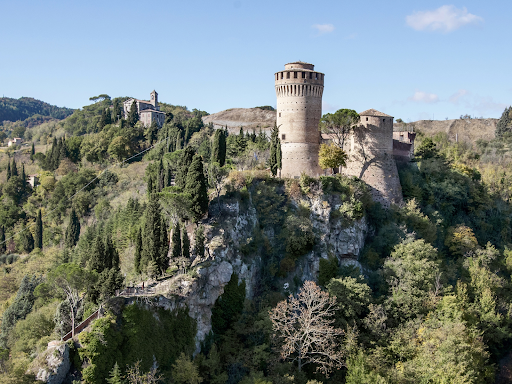
For many travellers, Italy means packed piazzas and busy museums. Yet there are corners of the country where the pace slows and history can be savoured in near silence. Approaching Brisighella in Emilia-Romagna, the landscape rises into steep rocky hills crowned by lonely towers and pine trees, setting the scene like a Renaissance canvas.
Brisighella’s charm continues in its streets. Medieval alleyways twist and turn, while a raised walkway slices through the town, creating tucked-away viewpoints and shady recesses. It’s as inviting to wander as it is to use as a base for hikes into the surrounding countryside.
On Sicily, the Via dei Frati trail links Caltanissetta to Cefalù across the Madonie mountains. Over 54 miles, the path delivers big skies, remote ridges and near-total solitude. Each stage ends in a village such as Gangi, where visitors are rare but hospitality is generous, even when English is absent.
Basilicata’s Venosa is another under-sung treasure. Once a thriving hub and birthplace of the poet Horace, today it is a modest town layered with Roman ruins, catacombs and a commanding castle. Around it stand more under-the-radar sights: the castles of Melfi and Lagopesole and the palace at Pietragalla are all destinations that would be famous in a more crowded region.
From an unplugged eco-hotel deep in the Apennines, to Cividale’s UNESCO-listed Lombard shrine, to Chioggia’s working canals, Santo Stefano d’Aveto’s rugged Ligurian peaks, Loazzolo’s sweet wines and the silent Roman city of Urbs Salvia, these places prove that Italy still has room for discovery. Away from the main routes, it’s possible to feel like a guest rather than part of a crowd.
Renaissance Hills, Silent Trails and Secret Towns: Italy’s Quiet Side
Picture Credit: www.commons.wikimedia.org
61