
The UN Security Council on Monday adopted a US-drafted resolution to implement President Donald Trump’s Gaza peace plan, but the move was marked by significant division as permanent members Russia and China abstained from the vote. The resolution, which authorizes an international stabilization force and a transitional “Board of Peace” for Gaza, passed because neither country used its veto. However, their ambassadors immediately complained that the US-led initiative sidelines the United Nations and leaves the international community in the dark about the plan’s execution.
Russian Ambassador Vasily Nebenzya delivered a sharp critique following the vote, arguing that the council was “giving its blessing” to a US-led plan “on the basis of Washington’s promises.” He expressed deep concern that the resolution grants “complete control” to the Trump-chaired Board of Peace and the international stabilization force (ISF), “the modalities of which we know nothing about so far.” China’s representative echoed the sentiment, lamenting the resolution’s failure to provide a clear and substantial role for the UN in overseeing Gaza’s future, a traditional domain for the global body.
The plan itself, endorsed after Israel and Hamas agreed to its first phase of a ceasefire and hostage release last month, is a comprehensive 20-point proposal from President Trump. The newly adopted resolution is seen as vital for legitimizing the transitional governance body and, critically, for reassuring potential troop-contributing countries to join the ISF. This force is tasked with the challenging mandate of demilitarizing Gaza, which includes decommissioning weapons and destroying all military infrastructure.
Reactions on the ground were starkly divided. Hamas, the militant group that controls Gaza, immediately rejected the resolution. In a strongly worded statement, the group labeled the plan an “international guardianship mechanism” and reiterated its refusal to disarm, framing its conflict with Israel as “legitimate resistance.” This sets the stage for a potential confrontation between Hamas fighters and the incoming international force. Conversely, the Palestinian Authority, which governs parts of the West Bank, issued a statement welcoming the resolution and affirming its readiness to help implement it. Diplomats noted that the PA’s support was a key factor in preventing a Russian veto.
For the United States, the vote was hailed as a major success. Ambassador Mike Waltz declared that the resolution “charts a possible pathway for Palestinian self-determination” and “dismantles Hamas’ grip.” President Trump celebrated it as “a moment of true Historic proportion.” However, the plan’s reference to a future “pathway to… statehood” for the Palestinians has caused friction in Israel, with Prime Minister Benjamin Netanyahu reaffirming his government’s opposition to such an outcome, highlighting the fragile and contentious nature of the road ahead.
UN Adopts Gaza Plan Despite Russian & Chinese Abstentions; Critics Cite Lack of UN Role
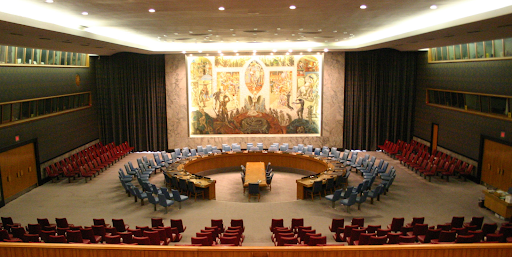
Picture credit: www.commons.wikimedia.org
63