
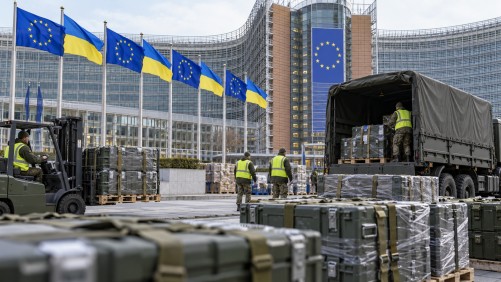
The European Commission has initiated a new €21.3 billion ($24 billion) funding round under the Security Action for Europe (SAFE) program, aimed at enhancing defense capabilities among European Union member states and providing support to Ukraine. Announced on October 29, this funding is part of the broader €150 billion SAFE initiative, which was introduced in May 2025 to boost defense investment and expand Europe’s military production capacity as part of the EU’s Readiness 2030 defense program.
EU Defence Commissioner Andrius Kubilius highlighted the importance of using these funds for joint procurement projects to address urgent defense needs, particularly for Ukraine. Among the priorities identified for Kyiv are air and missile defense systems, drones, counter-drone technology, and ammunition. Member states have until November 13 to submit their applications, with provisional funding allocations expected within two weeks of the deadline. The approved projects must be announced and fully implemented by June 30, 2027.
The current funding round follows the initial cycle, where 19 EU countries applied for loans totaling approximately €130 billion. However, some member states, such as Hungary, Italy, and France, reduced their borrowing requests, thereby freeing up additional funds for this latest round. Hungary notably decreased its application from €16.4 billion to €5.4 billion due to a change in government strategy.
In contrast, several EU countries, including Germany and the Netherlands, opted out of participating in the first round, citing more favorable national financing arrangements. Poland emerged as the largest applicant during that cycle, requesting €43.7 billion, and is expected to seek further support in the current round as it continues to bolster its defense capabilities. Other countries, such as Ireland and Greece, are also considering applying for the new funding.
The SAFE initiative seeks to strengthen Europe’s defense industry while addressing Ukraine’s immediate military requirements through coordinated procurement and investment. The Commission’s strategic emphasis on joint procurement aims to enhance the EU’s collective defense posture in the face of evolving security challenges. As the EU pushes forward with these efforts, the new funding cycle is set to play a pivotal role in shaping the region’s defense landscape over the coming years.