
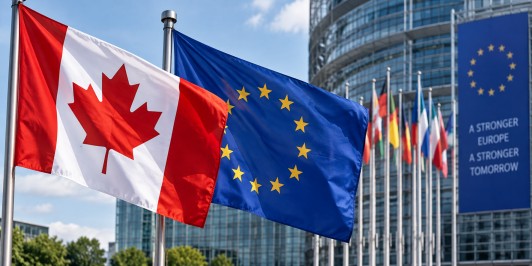
Amid escalating trade tensions with the United States, Canada is actively pursuing stronger economic and strategic connections with the European Union. Prime Minister Mark Carney has recently engaged in discussions with leaders from France, Germany, and Italy, seeking ways to draw Canada closer to the EU without committing to full membership. Canadian officials are considering an associate membership that would grant greater access to the EU’s single market.
This proposed collaboration is set to target key strategic sectors such as energy, artificial intelligence, critical minerals, defense, technology, and infrastructure. Additionally, Canada is contemplating enhanced partnerships in research, higher education, data centers, telecommunications, and satellite networks. A significant part of this initiative involves expanding energy links with Europe, especially through infrastructure projects that could facilitate the export of Canadian natural gas to European markets, thereby reducing Europe’s reliance on Russian energy sources.
The move reflects Canada’s strategic aim to diversify its economy and decrease its dependence on the United States, which currently absorbs approximately two-thirds of Canadian exports. By forging closer ties with the EU, Canada hopes to open new avenues for economic growth and collaboration.
European nations have shown cautious interest in these proposals. While deeper cooperation with Canada could unlock new economic opportunities, it also poses a potential challenge to the already delicate dynamics between Washington and its European allies.